
By Todd Paetznick, August 1, 2024
Our priorities are revealed by how we use our time.
Draw a horizontal line to represent your life. Segment the line into three parts to represent your childhood, adulthood, and elderhood. Mark how old you were/will be as you transition/expect to transition to the next stage of life. (You should have four dots to represent your birth, your age when you became an adult, when you became (expect to become) an elder, and the fourth dot on the far right end of the line representing your age when you expect to die and transition to eternity.)

Now, draw another line above and parallel to your lifeline. This gap between the two lines represents a 24-hour day. Between the two lines, you can represent how you use your time. Draw multiple stacked vertical bar graphs, with each stacked segment representing one of your activities. Each segmented line can represent a single day, a week, a year, etc. (You choose the granularity you want.)
Some examples of activities that make up our lives are listed below (not a complete list). Since most of us will probably not actually draw these lines or take the time to graph out your life, at least consider how the amount of time we dedicate to any particular activity over time:
- Spirituality
- Work (vocation)
- Family and children
- Friendships and social interactions
- Eating and food preparation
- Home maintenance
- Recreation (play)
- Education and learning
- Rest
- Investing in the lives of others. (This includes civic duty, mutual protection, coaching, teaching, mentoring, volunteering, etc.).
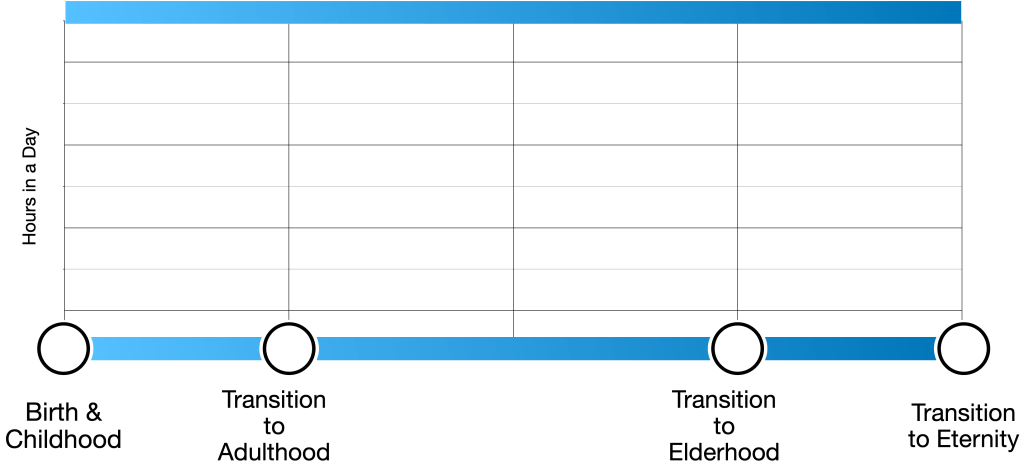
Make a note of when you faced major life changes. These can include going to college, that first big-person job after college, getting married, having children, owning a home, moving to a new town, becoming an empty-nester, having grandchildren, approaching retirement, early retirement, and other events. When change happens, your routine is often altered significantly; maybe not immediately because it can take some time to figure out a new and best routine, but eventually we will find a new and best pattern for living.
Pay close attention to how you used your time before and after major life changes; notice what parts of your life changed. Looking at the chart you just drew (or just imagining it), you should notice differences in how much you rested, worked, and played from childhood until now. The differences are completely appropriate. What is important to realize is that you are glorifying God when you are doing what you are supposed to be doing. As children, we play, learn, and rest more than we do as adults, which is as it is supposed to be. As adults, work and family become higher priorities and require a greater percentage of our time. Even though the activities differ between life stages, God can be glorified through what we do in our childhood, adulthood, and elderhood.
The point of the exercise is to reflect on our time usage and, with the benefit of hindsight, consider what we could have done differently to achieve a preferred outcome. Optimizing our time implies that there is a best path toward achieving an objective. Glorifying God through what we do should be the primary objective for Christ-followers regardless of our age. God is our top priority, what is the next most important priority in our lives? Does how we use our time accurately reflect what we say is most important? Or does it reveal something that is not a priority for us at all?
Glorifying God means we strive to be the best [your vocation here] that we can be. And that we strive to be the best [husband/wife, uncle/aunt, sibling, parent, child] that we can be. And that we are the best [friend, neighbor] that we can be. You get the idea. Each of the roles we hold in our lives — spouse, parent, friend, or employee — has a mix of activities associated with it that require a portion of our time. Understanding what it means to be “best” is based on a biblical standard, however, and not the opinions of people. We are all limited to 24 hours each day; which tasks are needed to achieve our priorities? What activity should become less of a priority?
One final note. How we use our time changes across our lives. Jesus taught His disciples to defer their rewards to their next life. “But store up for yourselves treasures in heaven, where neither moth nor rust destroys, and where thieves do not break in or steal; for where your treasure is, there your heart will be also” (Matthew 6:20-21 NASB20). We usually understand this teaching of Jesus to be about hoarding money and possessions that we cannot take with us to heaven. However, we can be equally greedy with the use of our time. Analyzing how we use our money is relatively easy because it is tangible and fits nicely on a spreadsheet. How we use our time is more complex because the mix of activities necessary to achieve our priorities will change across our lifetimes and even between people.
 FaithNet Connect
Leave a comment