
By Todd Paetznick, November 14, 2024
Biblical decision-making depends on knowledge of biblical principles, godly wisdom, and the acknowledgment that God is sovereign over all decisions and situations. Wisdom is not the same as experience. It is learning from experience and changing one’s actions to achieve a better outcome.
What is most urgent, and what is unimportant? Our lives often consist of the need to make many decisions. Sometimes, we can feel overwhelmed and paralyzed by the sheer number of decisions that need to be made or the complexity of significant choices. We are not the first people to face complex and challenging life decisions.
The President of the United States has some of the most complicated and consequential decision-making that affects millions (maybe billions) of people. Before he became president, Dwight D. Eisenhower was a military man who served as the General in charge of the Allied forces during World War II. The decisions he needed to make during the war often were the difference between the life and death of the people serving under his leadership. For efficiency, Eisenhower used a simple decision-making technique to prioritize decisions; it is now referred to as the Eisenhower Matrix and is used extensively by powerful people globally.
The Eisenhower Matrix is a quadrant-based system. It is a square divided in half vertically and horizontally, resulting in four smaller squares or quadrants. The Top Right quadrant contains urgent and important tasks and decisions. The Top Left quadrant contains Urgent but Not Important tasks. The Bottom Right quadrant contains important but not urgent tasks. The Bottom Left quadrant shows tasks that are not important and not urgent.
How to Use the Eisenhower Matrix
Wise Christ-followers use tools and techniques discovered and created sometimes outside the Bible as its source. Discernment is needed to determine whether a tool or technique operates within biblical principles. The Eisenhower Matrix is a useful tool that can enhance wise decision-making. However, sometimes, decisions can seem urgent and important when they are not. Categorizing tasks and decisions may reveal aspects of decisions that are not obvious on the surface.
Urgent – Important. Tasks and decisions with deadlines and significant consequences. Do these first.
Urgent – Not Important. Delegate urgent tasks and decisions that do not require your involvement or expertise but must be done quickly. If the task / decision cannot be delegated, give these items your second priority.
Not Urgent – Important. Tasks and decisions without definitive deadlines can be deferred to a less hectic time. These will be your third priority.
Not Urgent – Not Important. Do not waste your time on these items. Prioritization of items will sometimes reveal items that are not valuable at all. Delete these items from your matrix.
Revisit. Some tasks and decisions may not appear urgent or important, but their status changes over time. Similarly, some tasks and decisions may not have a deadline, but time reveals a different level of urgency.
An Eisenhower Matrix as a Spreadsheet.
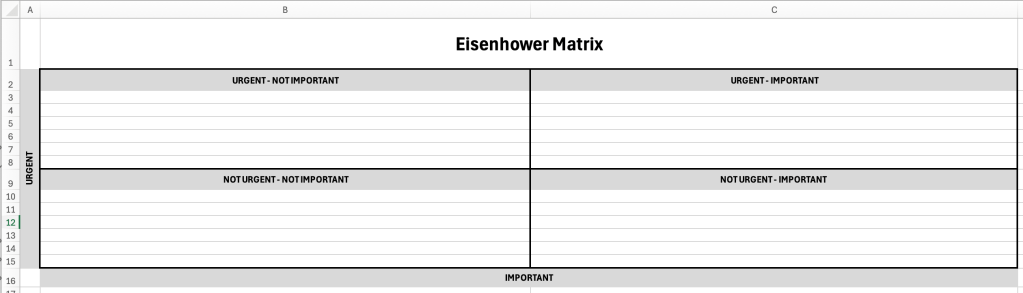
If you have access to Excel, you can download a simple version of an Eisenhower Matrix here.
 FaithNet Connect
Leave a comment